Anzac Day, 25 April, is one of the most meaningful public holidays in Australia and New Zealand. Anzac stands for Australian and New Zealand Army Corps, and the day commemorates those who served in the Gallipoli campaign during the First World War. Across the country, dawn parades, fundraising stalls and community services are held in their memory. Anzac biscuits — the same kind once sent to soldiers overseas — are eaten in remembrance, and around this time of year schools dedicate lessons to the First World War and the meaning of the day.
For our children, much of New Zealand's history and culture is still new ground. So rather than reaching for difficult texts, we lean on picture books — clearer entry points into ideas that ask a lot of a young reader. The Red Poppy by David Hill, illustrated by Fifi Colston, is one such book. It tells the story of a young New Zealand soldier and a small messenger dog on the Western Front, and it is widely used in NZ classrooms around Anzac Day. Min studied it last year as a school assignment.
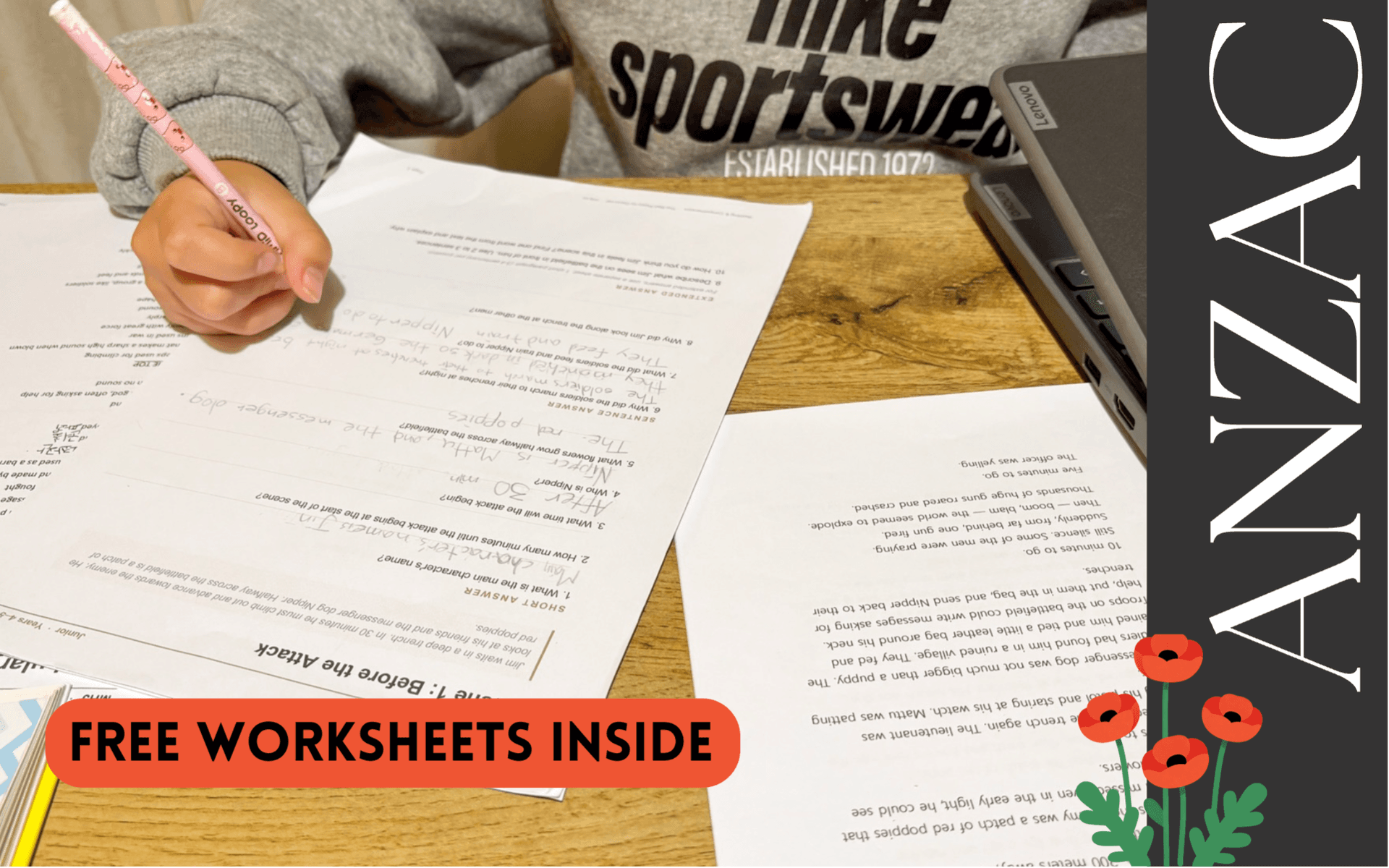
Last year the work was straightforward reading. This year, I wanted to take the book further — so I made our own writing worksheets, pitched one level below each child's current year. Hyun's set is Year 4–5; Min's is Year 6–7. I divided The Red Poppy into five scenes, and for each scene prepared a single page of mixed questions: short-answer, sentence-form, and an extended writing prompt.
How We Read and Worked Through the Book
The book deals with war and history, so the vocabulary is unfamiliar in places. I gathered the harder words into a separate glossary with simple English explanations. The children worked through them carefully, sometimes pencilling in Korean meanings beside words they couldn't quite catch.
Hyun's worksheets focus on comprehension and on naming the emotions and situations the text shows directly. Min's, pitched higher, link to the narrative writing she's been learning at school — tracing the indirect cues in the text, the moods between the lines, the relationships between characters and events. She's asked to step into the narrator's perspective and think about why a moment feels the way it does.
When a question stumps them, I rephrase it in plain Korean. The point isn't reading-comprehension-of-the-question — it's the thinking the question is meant to prompt. One scene a day, one page of writing. Slowly, the children are learning what it means to read deeply. The extended-writing sections also tell me, scene by scene, where each child needs more support in grammar or vocabulary.
Free Download: ANZAC Day Worksheets
Download the ANZAC Worksheets
The Red Poppy worksheets that we made for our own family are available below as a free download. The Red Poppy itself is easy to access through Auckland Libraries as an eBook, and a free audiobook version is also available — link in the info block below. We'd recommend reading along with the worksheets. If a parent isn't confident in English, or if the children would like to mark their own work, one practical option is to photograph the page and use AI to check the writing.
☑️ The Red Poppy Worksheets: Year 4–5
☑️ The Red Poppy Worksheets: Year 6–7
☑️ The Red Poppy Worksheets: Year 8
📌 Looking for more Anzac titles? We've curated six children's books on our Instagram.
📌Watermark removal, modification, and redistribution are not permitted.
Read More: [Y7] Intermediate Guide: Specialist Subjects

Yussi
Writer · Social work student, Massey University
A mother of three girls and a Korean immigrant making Mairangi Bay home — writing about starting school, home learning and everyday life on Auckland's North Shore.
More about Yussi →Join the conversation
Comments
Loading comments...
From our family · StoryPress
Every child has a story. Let them write it.
A five-year-old's daily sentence, growing word by word.
Join the Waitlist →
![[Y7] Kahu Manu (1) New way of learning](/_next/image?url=https%3A%2F%2Fvpayqdatpqajsmalpfmq.supabase.co%2Fstorage%2Fv1%2Fobject%2Fpublic%2Fimages%2Fblogs%2F1780228905567.png&w=1920&q=75)