As the days turned cooler, the children spent weeks coming home with sweat on their backs. Cross country was approaching, and practice had been in full swing for some time. On afternoons when training was on, Hyun — now in the senior school — would trudge out to meet us, completely worn out.
Cross country, run across fields and open grass, is one of the big annual events on the New Zealand primary and intermediate calendar. It usually falls in Term 2, somewhere between autumn and early winter. From Year 0 right through to Year 8, every child takes part, and the greatest weight is placed not on winning but on finishing. There are placings and prizes by year level, but even the child who comes in last earns a heartfelt round of applause for getting to the end.
How the Race Is Run
Distances, courses, and starting groups are set by year level — the juniors run in the morning, the seniors in the afternoon — each child dressed in the colour of their whānau house. Jin, in Year 1, ran a course that began on the school field, looped roughly halfway around the grounds, and came back in. "Halfway" undersells it: between the field, the courts, the buildings and the car parks, the school sits on a fair stretch of land, and it's no easy distance for a Year 0 or 1 to finish. The senior course is tougher still. The children head out of the gates, trace a wide loop around that large school site, wind through the very streets where their friends live, and only after a good while do they finally come back to school.
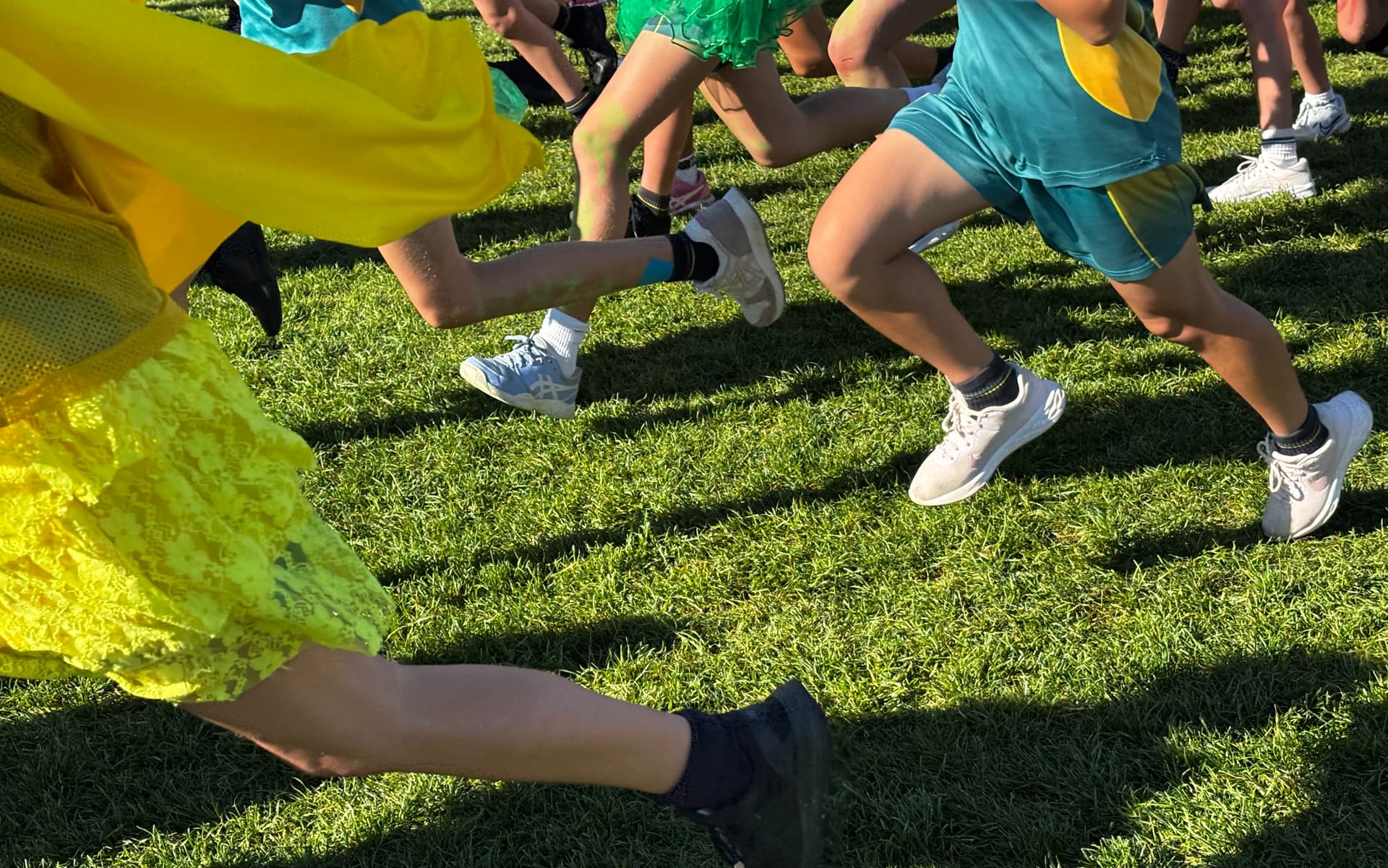
At the start line, the costumes catch your eye first — even boys turned up in tutus, in the colours of their house, ready to run. Then the gun goes, and they pour forward all at once, a tangle of legs lifting off the grass.
And still they run. Not on a smooth, sealed track but over grass, over dirt paths, over the very ground we live on — running until the breath catches in their throats. When they cross the finish line, the tiredness is plain on their faces, but brighter than that is the sheer joy of having made it.
And even when a child is hurt, they keep coming in. Limping, hopping on one leg, with friends pressing in on either side to hold them up — and in that moment the runner and the ones carrying them become a single team. The last to cross don't arrive as stragglers, but as the ones who bring the race home. Some have pulled off their shoes along the way and run the final stretch barefoot. And the little ones — the moment they catch sight of the finish line, they dig deep for one last burst of speed, small saplings straining up toward the light.
Community and Solidarity at the Finish
The intermediate students, just two year levels, hold their cross country in the afternoon. Parents are invited from the start, and the event opens to a roar of encouragement. Even in the cold, the children run in their short PE gear, oblivious to the chill. All along the route, teachers keep things safe and cheer them on.
When the running is done, everyone gathers back at the start, and each mini-school belts out its own chant — a song of one heart, of solidarity. Voices clear and joined, moving as one, the mini-school chants stay with you long after. Kia kaha, kia toa, kia manawanui! Strong, brave, and steadfast — here's to our children, running.
Read More: Top Team Competition

Yussi
Writer · Social work student, Massey University
A mother of three girls and a Korean immigrant making Mairangi Bay home — writing about starting school, home learning and everyday life on Auckland's North Shore.
More about Yussi →Join the conversation
Comments
Loading comments...
![[Y1] Year 0/1 Beach Trip](/_next/image?url=https%3A%2F%2Fvpayqdatpqajsmalpfmq.supabase.co%2Fstorage%2Fv1%2Fobject%2Fpublic%2Fimages%2Fblogs%2F1792726900809.jpeg&w=1920&q=75)