Min's Homework
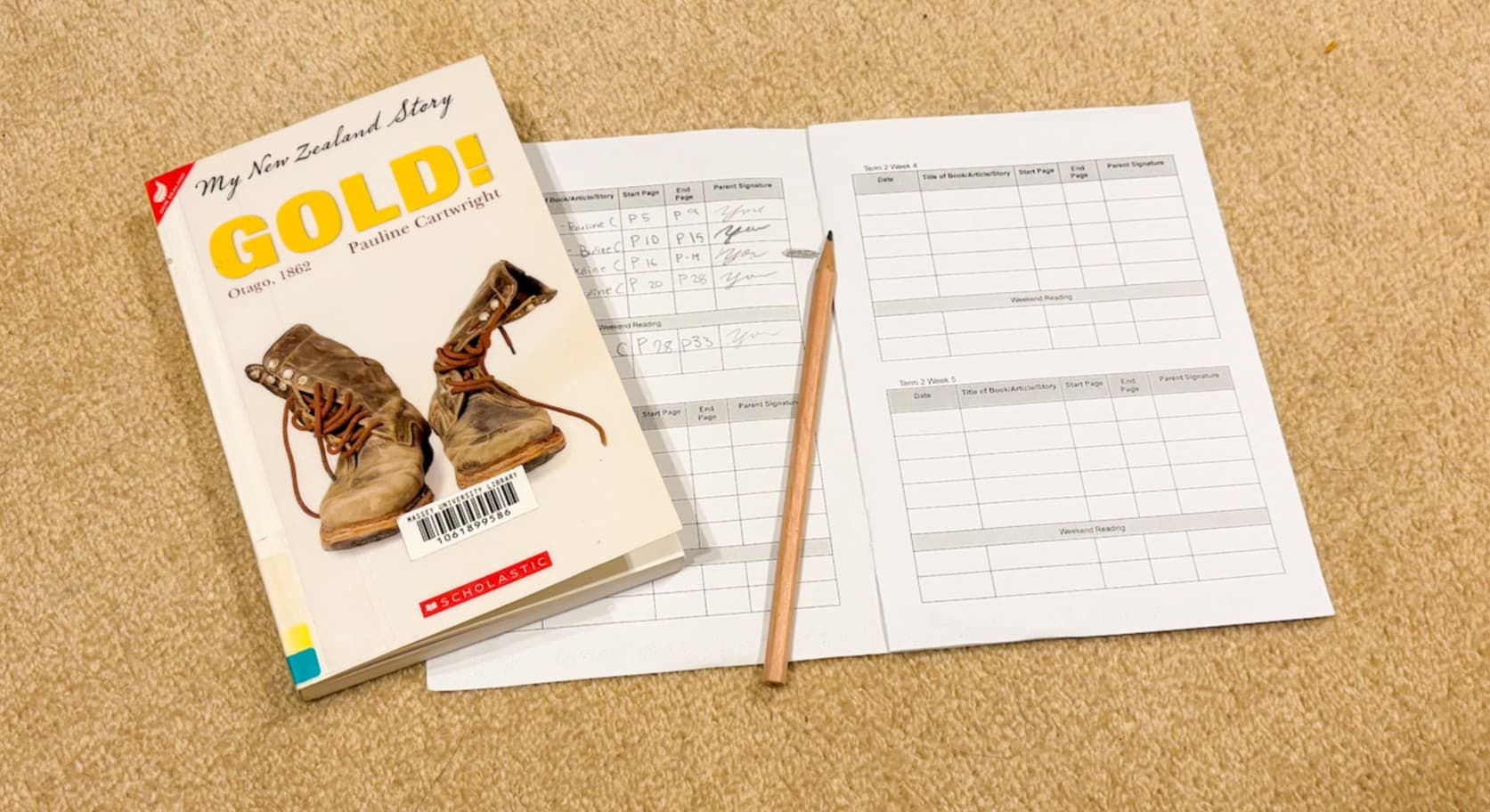
Min came home with a Read Aloud Log from school. Every day, for 15 minutes, she's to read out loud to someone — a parent, a sibling, the dog or the cat — record the pages, and have a parent sign off. From the My New Zealand Story series, which she'd been eyeing for a while but kept finding too daunting, she pulled Gold off the shelf.
My New Zealand Story is a series of historical fiction told as the diaries of children living through pivotal moments in this country's history — the signing of Te Tiriti, the Otago gold rush, the Tangiwai disaster, the 1981 Springbok Tour. For children who came to New Zealand later and have very little sense of its history, the series is a gentle, immersive way in. Gold sits a little above Min's comfort level in both length and language, so I borrowed a few volumes from the Education collection at Massey's library, where loan periods stretch much further than at the public library — a quiet luxury when a book needs to be read slowly. She had tried it once before and managed only a page or two before giving up; this time, with the school log in hand, she gathered herself for another go.
From that day, every evening after dinner, Min would settle next to me with the book. 15 minutes is short and somehow long at the same time — she always seemed surprised when it was over, but she was steadily covering three or four pages a day. Place names and people's names still tripped her up, and she'd glance over to ask how to say them. I'd listen as she read, and now and then offer something small — to pause properly at the commas and full stops, or to lean into the rhythm a little more rather than running the words flat. When she finished, she'd write down the last page and bring me the log to sign. I'd ask her, casually, what had happened in today's section, and she'd tell me. If she missed something important, I'd add it gently — and this also happened, didn't it — and leave it there. She read quickly, but she was holding the thread of the story, and I realised her English had come a long way.
Louder, again louder
Hyun didn't have the same homework, but it occurred to me that this approach might be exactly what she needed. Hyun resists speaking English in particular, and her vocabulary is still quite thin, so the better path with her was thin books in greater numbers. We set a goal: finish two Level 2 reader series by the end of May. On the first day, we did shared reading — she read one sentence, I read the next. On the second, I tried to listen more closely to her, but her head was down, her lips barely moving, and even the simple words came out as a soft mumble I could hardly catch.
So on the third day, I changed tack. Instead of sitting beside her, I had Hyun take the armchair across the room and I sat on the sofa, far enough away that she'd have to read clearly for me to hear. I asked her to hold the book up at shoulder height and read facing forward. Her face was full of irritation, but the voice still kept slipping back down to a mumble. I had her read a Korean picture book at full volume first, then carry that same volume into the English reader. Louder, again louder — over and over, while she grew angrier and angrier — but I couldn't back down.
We always wonder whether pressing a child as anxious as Hyun is the right thing. But even if we wait, time doesn't. When a parent becomes a permanent escape hatch, the one who ends up struggling more is the child who, eventually, has to walk forward on her own. No parent sends a child out into a snowstorm in summer clothes just because the layers feel stifling. You wrap her in a coat, you tie a scarf around her neck, and with that same heart, you nudge her slow steps forward.
Read More: Learning Aid: Scholastic Book Club

Yussi
Writer · Social work student, Massey University
A mother of three girls and a Korean immigrant making Mairangi Bay home — writing about starting school, home learning and everyday life on Auckland's North Shore.
More about Yussi →Join the conversation
Comments
Loading comments...
From our family · StoryPress
Every child has a story. Let them write it.
A five-year-old's daily sentence, growing word by word.
Join the Waitlist →
![[Y7] Kahu Manu (1) New way of learning](/_next/image?url=https%3A%2F%2Fvpayqdatpqajsmalpfmq.supabase.co%2Fstorage%2Fv1%2Fobject%2Fpublic%2Fimages%2Fblogs%2F1780228905567.png&w=1920&q=75)