![[Edu] How To Read a Mid-year Report](/_next/image?url=https%3A%2F%2Fvpayqdatpqajsmalpfmq.supabase.co%2Fstorage%2Fv1%2Fobject%2Fpublic%2Fimages%2Fblogs%2F1782645126986.png&w=1920&q=75)
The first time a New Zealand school report lands in your inbox, it can feel like a wall of charts and percentages in a language you half-recognise. A sliding scale, a line of text, a paragraph from the teacher, a row of attendance numbers. If you grew up with a report card that ranked your child against the rest of the class, none of it quite maps onto what you knew.
So before reading yours closely, it helps to know what each part is actually for, and just as importantly, what it is not for. Here is how we've come to read ours.
1) What's on the mid-year report
A New Zealand primary report covers a handful of learning areas, usually Reading, Writing, and Mathematics, sometimes Oral Language as well, followed by a General Comment from the teacher and an Attendance record.
Each learning area tends to show the same three things in different forms. There's a progress graph, usually a sliding scale, which places where your child is sitting. There's a short line of text, currently working towards expectation at…, which is the part that actually names their level. And there's a list of skills, split into what your child has completed and what they are learning to do next.
The shape varies by school. Schools use different systems to put reports together, so your graph and wording may not look identical to another family's. What stays the same underneath is the question every section is answering: where is this child, in their own learning, right now?
2) How to read a progress graph
It's natural to go straight to the numbers, or to the point on the scale that names a year level. But the graph is better understood as a position, not a score.
The sliding scale shows roughly where your child is working against the expectation for their year. The bands, towards, at, above, aren't marks. They place your child against what's expected at their year level, not against the other children in the room. A point sitting at towards isn't a low grade; it's a child on their way through a stage.
Some schools don't use towards / at / above at all. They use a row of words instead — Emerging, Developing, Consolidating, Proficient, Exceeding — and the one that stops most parents is Consolidating. It doesn't mean stuck, and it isn't a C. It means the skill has been taught, and your child is now practising it until it holds. At mid-year, Consolidating is what on track looks like for most children. The same word on an end-of-year report is read more strictly, because by then there has been a full year to practise. Schools word these differently, so read them against your own school's key.
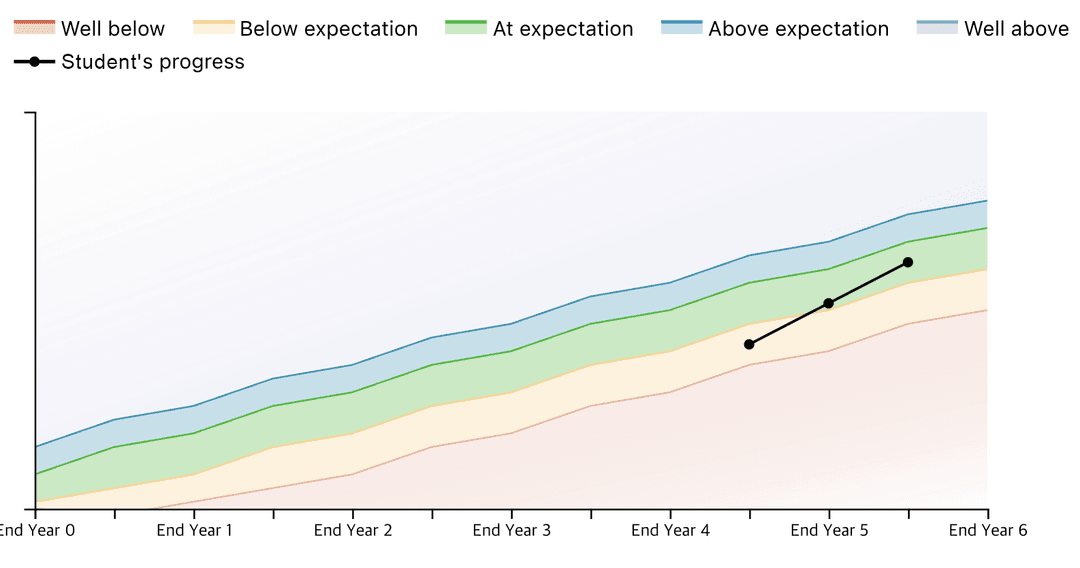
But the most useful part of the whole report is usually the quietest: the has completed / learning to lists. The scale tells you roughly where; these lists tell you what. What your child can already do, and the very next thing they're reaching for. That's the part you can actually use at home, not to push, but to know where they're up to. If reading shows decoding two-syllable words as the next step, you know what a story together is quietly building towards.
Read each subject on its own, too. A child can be well along in one area and just starting out in another, and that's ordinary. The skills sit on different timelines, and strength in maths doesn't have to arrive in step with reading. And for a child early in their schooling, or early in their English, a report that looks sparse and full of learning to is not a report that's behind. It's a snapshot of someone in the middle of the work.
3) Understanding the General Comment
The numbers can only hold so much. The General Comment is where the teacher writes about the parts a chart can't reach: how your child meets a task, settles into the day, recovers from a small setback, sits among their classmates.
This is the section I read most carefully, and I read it for one thing first. Do I recognise my own child in it? Not whether the marks are high, but whether the child I've watched for years shows up in the teacher's words, even when the words aren't the ones I'd use. A child can't fully hide their temperament, so when a teacher catches it, it tells me they've watched closely and thought about who this particular child is.
When parts of it don't match what I see at home, I try not to treat that as something to correct. A child is often different at home and at school, louder at the kitchen table, quieter at their desk, talkative at break but more reserved when asked to speak up in class. Both are real. If something I know isn't there in the comment, it usually means my child didn't show that side at school, or that a busy classroom, with many children needing attention, leaves less room to notice the quiet ones. Neither is anyone's fault.
What the comment gives me, in the end, isn't a verdict. It's a sense of how my child is seen, and a starting point for what I might mention, or ask, when I meet the teacher.
4) Paying attention to the attendance
The attendance row looks simple, but two things are worth knowing.
First, it's counted in half-days, not days. Each day is a morning session and an afternoon session, so a full day away shows up as two absences, and a half-day, such as a midday medical appointment, as one. That's why the totals can look higher than the number of days you actually remember.
Second, absences are split into justified and unjustified. A sick day or a doctor's visit is justified; a day taken for family reasons, travel or a parent's commitments, is usually recorded as unjustified. The label is an accounting category, not a judgement. It doesn't mean you did anything wrong, only how the day is counted. Across 2026, schools are paying closer attention to attendance, with term-time holidays and illness the two patterns most in focus.
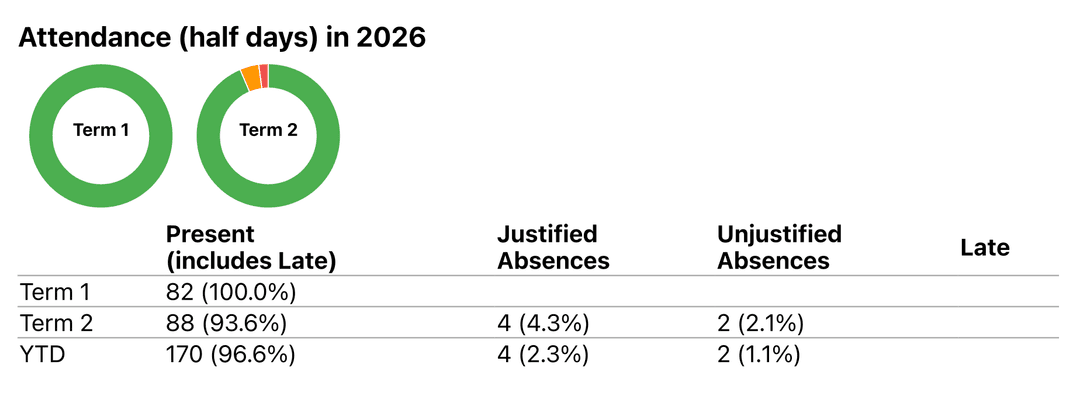
Two days unwell, one with family.
Our own rule is simple. Unless they're genuinely unwell or worn out, they go. Not to chase a percentage, but because missing tends to feed on itself: the more a child is away, the easier staying away becomes. The balance runs both ways. A child who's sick should rest; a child who's just reluctant is better off keeping the rhythm. If you're ever unsure how your own school treats a particular absence, that's a fair thing to ask them directly.
한국어 요약
뉴질랜드 학교 성적표를 처음 받으면 그래프와 짧은 문구, 출석 숫자가 한꺼번에 쏟아져 낯설다. 반에서 몇 등인지를 알려 주던 성적표에 익숙하다면 더 그렇다. 이 글은 초등 중간 성적표(mid-year report)의 각 부분이 무엇을 말하고 무엇을 말하지 않는지를, 우리 집이 읽는 방식대로 정리한 것이다.
성적표는 보통 Reading, Writing, Mathematics와 담임의 General Comment, 출석 기록으로 이루어진다. 진도 그래프의 towards·at·above는 점수가 아니라 위치다. 다른 아이와의 비교가 아니라 그 학년의 기대 수준에 비춘 자리이고, 가장 쓸모 있는 부분은 '해낸 것'과 '다음에 배울 것' 목록이다. General Comment에서는 점수보다 그 글 속에 내 아이가 보이는지를 먼저 읽는다.
출석은 하루가 아니라 반일 단위로 센다. 하루 결석은 2회로 찍히고, 아파서 쉰 날은 justified, 가족 사정이나 여행은 대개 unjustified로 분류된다. 이 구분은 평가가 아니라 집계 방식이다. 글 아래에는 다섯 단계 진도 표현(Emerging부터 Exceeding까지)을 학기 중간과 학년 말에 어떻게 다르게 읽는지 표로 붙였다.

Yussi
Writer · Social work student, Massey University
A mother of three girls and a Korean immigrant making Mairangi Bay home — writing about starting school, home learning and everyday life on Auckland's North Shore.
More about Yussi →Frequently asked questions
- What does "Consolidating" mean on a New Zealand school report?
- It means the skill has been taught and your child is practising it until it holds — not that they are stuck, and not a C grade. At mid-year, Consolidating is what being on track looks like for most children; at year's end the same word is read more strictly, because there has been a full year to practise. Schools word their levels differently, so check your school's own key.
- What do "towards", "at" and "above" mean on a New Zealand school report?
- They are positions, not marks. The bands place your child against what is expected at their year level, not against the other children in the room. A point sitting at "towards" isn't a low grade — it's a child on their way through a stage.
- What do the five progress descriptors mean on a mid-year report?
- Emerging, Developing, Consolidating, Proficient and Exceeding describe progress against one child's own year level. The same word is read differently mid-year and at year's end — at mid-year, Consolidating already means on track. The exact words may differ on your school's report.
- Why does the attendance record show more absences than the days my child missed?
- Attendance is counted in half-days, not days. Each day is a morning session and an afternoon session, so a full day away shows up as two absences, and a midday medical appointment as one.
- What is the difference between a justified and an unjustified absence?
- A sick day or a doctor's visit is justified; a day taken for family reasons or travel is usually recorded as unjustified. The label is an accounting category, not a judgement. If you're unsure how your school treats a particular absence, ask them directly.
Join the conversation
Comments
Loading comments...
![[Y1] First Term Report](/_next/image?url=https%3A%2F%2Fvpayqdatpqajsmalpfmq.supabase.co%2Fstorage%2Fv1%2Fobject%2Fpublic%2Fimages%2Fblogs%2F1775219643298.png&w=1920&q=75)
![[Y7] Part 1: English & Mathematics](/_next/image?url=https%3A%2F%2Fvpayqdatpqajsmalpfmq.supabase.co%2Fstorage%2Fv1%2Fobject%2Fpublic%2Fimages%2Fblogs%2F1774462681463.jpeg&w=1920&q=75)
![[Y7] Understanding Year 7](/_next/image?url=https%3A%2F%2Fvpayqdatpqajsmalpfmq.supabase.co%2Fstorage%2Fv1%2Fobject%2Fpublic%2Fimages%2Fblogs%2F1774462705932.jpeg&w=1920&q=75)