![[Edu] Keeping Ourselves Safe](/_next/image?url=https%3A%2F%2Fvpayqdatpqajsmalpfmq.supabase.co%2Fstorage%2Fv1%2Fobject%2Fpublic%2Fimages%2Fblogs%2F1780474104440.jpeg&w=1920&q=75)
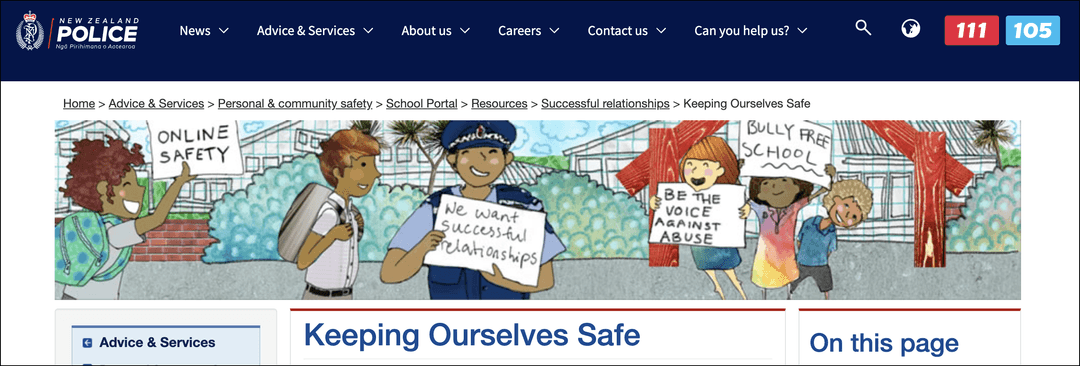
This afternoon I went along to a parents' session at Jin's school about a programme called Keeping Ourselves Safe (KOS), which I had signed up for in advance. In the school hall, a police officer walked a room full of parents through how the school plans to teach children about a sensitive subject — child abuse — in a safe way. It was a session not to teach us, but to tell us beforehand what our children will be taught.
Child abuse is taken very seriously here. Behind New Zealand's shining reputation as a paradise for children lies a heavier shadow: by some measures, it has one of the worst records for child abuse and neglect in the developed world. The government runs a range of programmes and campaigns for children's welfare and wellbeing, and the KOS introduced today is part of that effort.
How Keeping Ourselves Safe Works
Where "stranger danger" was once the slogan for protecting children from abuse and abduction, even that phrase is now changing. The evidence points to abuse being committed more often by someone the child knows — a familiar, close face — than by a stranger. So the focus has shifted from the person to the situation: children are taught to trust their own instincts and to act when they themselves feel uneasy or unsafe. When they feel frightened or uncomfortable, they are guided to go to a trusted person nearby — a police officer in uniform, a shop worker in uniform or wearing a name badge, a parent with children — and ask for help.
KOS runs across Year 0 to 13 in five stages: Junior Primary (Years 0–3), Middle Primary (Years 4–6), Senior Primary (Years 7–8), Secondary Junior (Years 9–10) and Secondary Senior (Years 11–13). Each stage uses language and visual material suited to that age, helping children recognise what abuse is, and who to turn to, and how, for help. The programme runs in every school.
Child abuse is broadly grouped into six types. Alongside the traditional categories — physical, sexual, emotional and neglect — digital abuse, including online grooming, is now emphasised, and family harm is also classed as child abuse even when no direct injury is done to the child. Repeated conflict and fighting at home, in particular, leaves a child in deep anxiety and fear, so creating a positive environment for the child is treated as something that matters.
What the Session Said to Parents
What struck me most about today's session was how concretely it set out what children and adults should each do, from where they stand. To children, KOS says: it is not your fault; tell a trusted adult and ask for help; and if nothing changes, do not stop there — keep telling other people, keep asking for help until something does change. To adults, it says: listen properly; believe the child; thank them for telling you; and find a way to help.
![[Edu] Keeping Ourselves Safe — photo 1](/_next/image?url=https%3A%2F%2Fvpayqdatpqajsmalpfmq.supabase.co%2Fstorage%2Fv1%2Fobject%2Fpublic%2Fimages%2Fblogs%2F1780474582922-zfzft.jpg&w=1080&q=75)
![[Edu] Keeping Ourselves Safe — photo 2](/_next/image?url=https%3A%2F%2Fvpayqdatpqajsmalpfmq.supabase.co%2Fstorage%2Fv1%2Fobject%2Fpublic%2Fimages%2Fblogs%2F1780474588172-o9h4q.png&w=1080&q=75)
![[Edu] Keeping Ourselves Safe — photo 3](/_next/image?url=https%3A%2F%2Fvpayqdatpqajsmalpfmq.supabase.co%2Fstorage%2Fv1%2Fobject%2Fpublic%2Fimages%2Fblogs%2F1780474594487-ua2f7.jpg&w=1080&q=75)
There will be no shortage of people in the world who would take a child's laughter from them. But far more people than that are gathering — working hard so that no child's faint voice dissolves into the air, so that it reaches someone and brings about a change that is small but large. That is why we do not let go of hope.
As a mother raising three children, I hope to be someone who can be there as a "trusted adult". And at the same time, I hope for a world in which children never have to go searching for a "trusted person" at all.
Read More: Starting School in New Zealand

Yussi
Writer · Social work student, Massey University
A mother of three girls and a Korean immigrant making Mairangi Bay home — writing about starting school, home learning and everyday life on Auckland's North Shore.
More about Yussi →Frequently asked questions
- What is the Keeping Ourselves Safe programme?
- Keeping Ourselves Safe (KOS) is a child abuse prevention programme taught in New Zealand schools and led by the Police. It helps children recognise when a situation feels unsafe, and shows them who to ask for help and how. It runs in every school.
- What year levels does Keeping Ourselves Safe cover?
- It runs from Year 0 to Year 13 in five stages: Junior Primary (Years 0–3), Middle Primary (Years 4–6), Senior Primary (Years 7–8), Secondary Junior (Years 9–10) and Secondary Senior (Years 11–13). Each stage uses language and visual material suited to that age.
- Why does the programme no longer teach "stranger danger"?
- Because the evidence points to abuse being committed more often by someone the child already knows than by a stranger. The focus has moved from the person to the situation: children are taught to trust their own instincts and to act when they feel uneasy or unsafe, whoever they are with.
- Who are children told to ask for help?
- A trusted person nearby — a police officer in uniform, a shop worker in uniform or wearing a name badge, or a parent with children. Children are told it is not their fault, to tell a trusted adult, and to keep telling other people until something changes.
- What happens at the parent session?
- A police officer walks parents through how the school will teach the subject. The session is not there to teach parents — it is to tell them beforehand what their children will be taught, so they can follow it up at home.
Join the conversation
Comments
Loading comments...
![[Edu] How To Read a Mid-year Report](/_next/image?url=https%3A%2F%2Fvpayqdatpqajsmalpfmq.supabase.co%2Fstorage%2Fv1%2Fobject%2Fpublic%2Fimages%2Fblogs%2F1782645126986.png&w=1920&q=75)
![[Edu] NCEA Is Changing: Following the Curriculum Shake-Up](/_next/image?url=https%3A%2F%2Fvpayqdatpqajsmalpfmq.supabase.co%2Fstorage%2Fv1%2Fobject%2Fpublic%2Fimages%2Fblogs%2F1779586525636.png&w=1920&q=75)