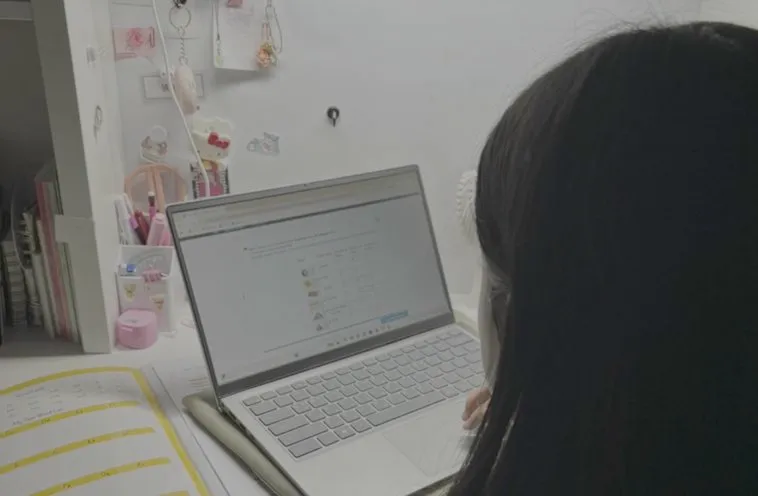
We started two weeks before school reopened — a month before my own semester begins. The approaching school year gave the children something to feel excited about, which made getting started a little easier. But beginnings are always transitional. Rather than charging ahead with ambitious targets, I went into the first two weeks with one goal: find the errors in the plan. And as expected, there were plenty.
The Older Child's First Week
Min — The Shepherd Girl Lost in Numbers
The original plan was e-ako, a Korean maths workbook, literature reading, and the Self-Directed Learning Project. Reading held up well from the start. Everything else needed work.
Maths was the first to crack. Min hit new concepts she wasn't ready for, and the workbook became a wall rather than a path. The Self-Directed Learning Project — designed to build research and writing skills — left her confused about how to allocate time and organise her thinking. And e-ako, which she reported completing, turned out to have barely been touched.
Adjustments YouTube tutorials first, then the workbook. The Science project got broken into daily sub-topics with immediate check-ins. E-ako verification moved from verbal reports to photo submissions. And we added daily Duolingo missions for the whole family — a small thing, but it gave everyone a shared rhythm.
The Younger Child's Enthusiasm
Hyun — Full of Enthusiasm, Short on Vocabulary
StepsWeb, daily reading, and e-ako all went smoothly. The problem was enthusiasm outrunning capacity. Hyun decided on her own that three workbook pages a day wasn't enough — she wanted six. A few days later, she quietly admitted six was too many. We reset to three, with any extra left to her discretion.
The bigger issue was the Sentence Structure Study. The level wasn't particularly hard, but Hyun didn't know enough words to interpret what she was reading. Meaning kept slipping away.
Adjustments We paused the Sentence Structure Study and rebuilt from the ground up: daily word search, understanding meanings, writing each word five to ten times. Short and repetitive — not glamorous, but suited to someone who finds sitting down to memorise words genuinely difficult. StepsWeb, independent writing, and her daily reader will reinforce the vocabulary as it builds. Duolingo added here too.
Flexibility: Our Greatest Advantage
The greatest advantage of home learning is being able to change course whenever you need to. Not to postpone things for convenience — but to change strategy in response to what's actually happening. If vocabulary turns out to be the weak point, set aside sentence structure and build word power first. If a short-term goal appears, sprint through it together. Even in those moments of improvisation, the children are still moving forward. That short sprint is, after all, part of a much longer race.
Read More: How Our Study Plan Fell Apart (AGAIN)

Yussi
Writer · Social work student, Massey University
A mother of three girls and a Korean immigrant making Mairangi Bay home — writing about starting school, home learning and everyday life on Auckland's North Shore.
More about Yussi →Join the conversation
Comments
Loading comments...
From our family · StoryPress
Every child has a story. Let them write it.
A five-year-old's daily sentence, growing word by word.
Join the Waitlist →
![[Y7] Kahu Manu (1) New way of learning](/_next/image?url=https%3A%2F%2Fvpayqdatpqajsmalpfmq.supabase.co%2Fstorage%2Fv1%2Fobject%2Fpublic%2Fimages%2Fblogs%2F1780228905567.png&w=1920&q=75)