

One afternoon, something shifted.
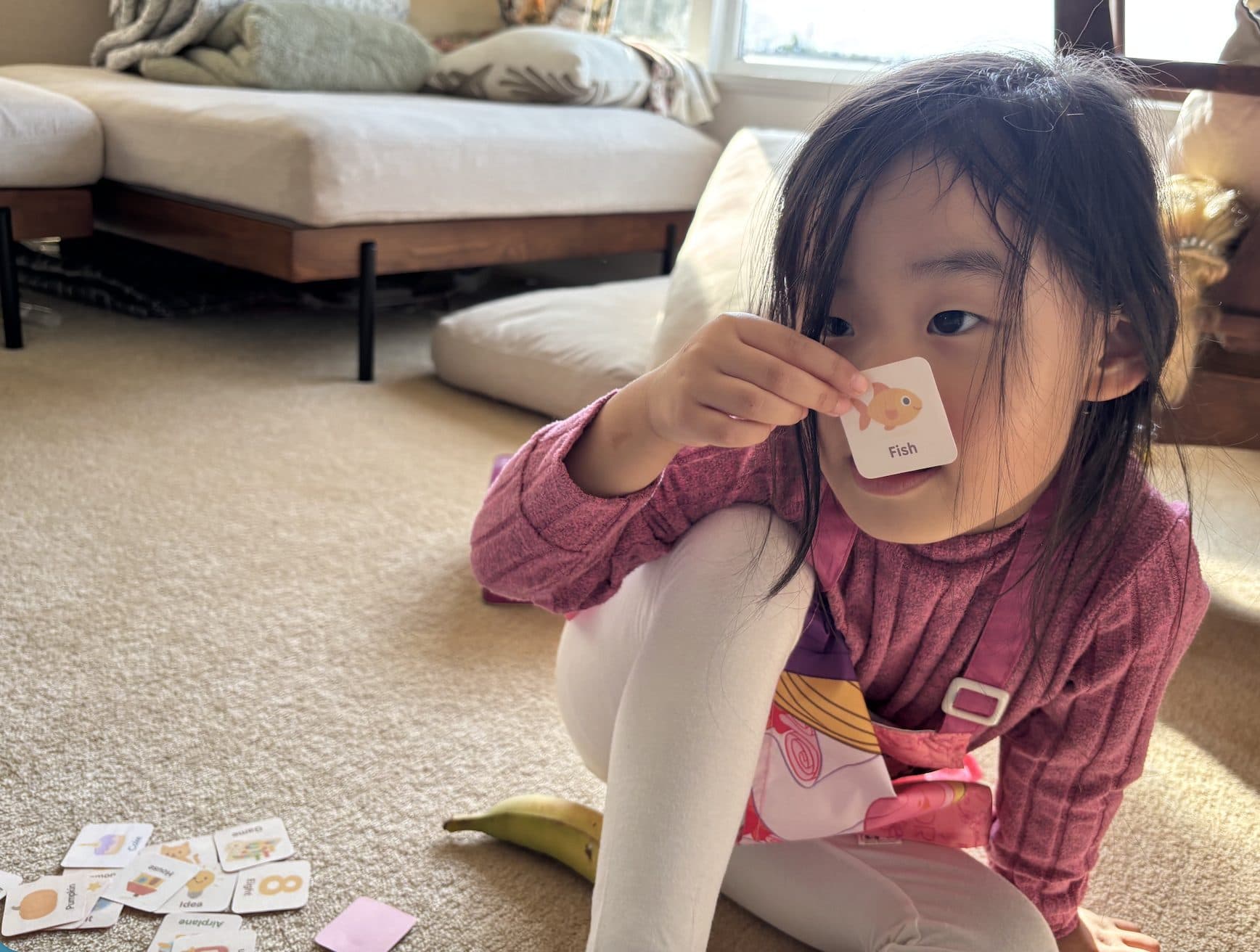
She picked up a handful of cards on her own and started talking to me — not asking to learn, just... playing. She held up the princess card and said, in her mix of Korean and fledgling English, "Mummy, where are you?" Then she grabbed the queen card, held it up on my behalf, and answered herself: "엄마 여기 있단다" — I'm right here, darling.
She was making a story.
The Stories Kept Growing
I didn't interrupt. I just played along, slipping in a simple English word here and there, nudging the plot gently when it seemed to stall. She didn't notice she was learning. She was too busy being the author.
Our Big Learning Realisation
Over the following days, the stories got longer. More cards joined the cast. The vocabulary she'd been drilling became characters, settings, plot twists. And every time a new word appeared in her story — one she'd learned just that week — something clicked in a way that no worksheet or app had quite managed.
That was the moment we started to see it clearly: the goal wasn't to get English into her. It was to give her something to do with it.
Read More: What We Tried — Nothing Quite Fit
한국어 요약
어느 오후, 막내가 단어 카드 몇 장을 혼자 집어 들더니 배우려는 게 아니라 놀기 시작했다. 공주 카드를 들고 한국어와 서툰 영어를 섞어 "Mummy, where are you?" 하고 묻고는, 여왕 카드를 내 대신 들어 "엄마 여기 있단다" 하고 스스로 답했다. 아이는 이야기를 만들고 있었다.
나는 끼어들지 않고 같이 놀았다. 쉬운 영어 단어를 하나씩 슬쩍 얹고, 이야기가 막힐 때만 살짝 밀어 주었다. 며칠 사이 이야기는 길어졌고, 외우던 단어들은 등장인물이 되고 배경이 되고 반전이 되었다.
그때 분명해졌다. 목표는 아이 안에 영어를 넣는 것이 아니라, 영어로 할 일을 주는 것이었다. 글 아래 가이드에는 몬테소리 3단 카드와 스토리 스톤을 집에서 시작하는 방법을 정리해 두었다.

Yussi
Writer · Social work student, Massey University
A mother of three girls and a Korean immigrant making Mairangi Bay home — writing about starting school, home learning and everyday life on Auckland's North Shore.
More about Yussi →Frequently asked questions
- How do word cards help a child who is learning English as an additional language?
- They separate knowing a word from using a word. When a child picks up a card and puts it into a story she invented, the vocabulary moves from passive to active — without the child noticing she is learning.
- What are Montessori 3-part cards?
- A picture card, a word card, and a control card that shows the picture and word together for self-checking. They have been used with children aged 3–6 for over a century: the child matches, sorts and self-corrects, with no drilling required.
- How do you make story stones at home?
- River pebbles, acrylic paint and a coat of varnish. Paint a character, setting or object on each stone and let your child combine them into a story. It takes about 30 minutes and costs under $20.
Join the conversation
Comments
Loading comments...
From our family · StoryPress
Every child has a story. Let them write it.
A five-year-old's daily sentence, growing word by word.
Join the Waitlist →